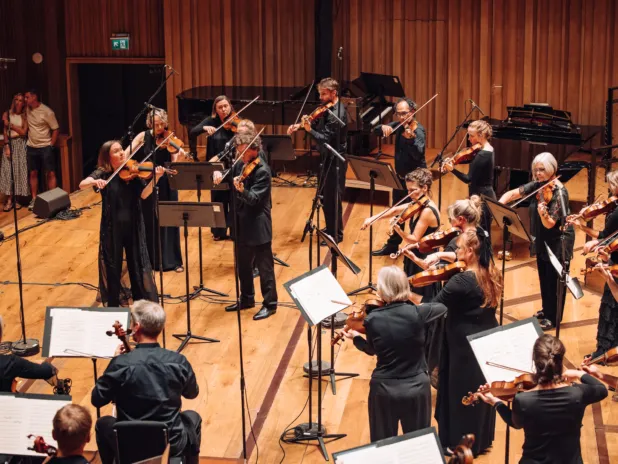
ALDEBURGH FESTIVAL II: PHAEDRA

Clicking "Buy tickets" below will take you to the booking page of an external website.
Performers
- Helen Charlston
- mezzo-soprano
- Zoë Beyers
- violin/director
- Britten Sinfonia
Programme
- Britten
- Young Apollo, Op.16 (8’)
- John Woolrich
- Ulysses Awakes (6’)
- Charpentier
- Quel prix de mon amour (from Médée) (6’)
- Haydn
- Cantata: Arianna a Naxos (18’)
- Stravinsky
- Apollon musagète “Apollo” (26’)
- Britten
- Phaedra, Op.93 (15’)
An evening of obsession, abandonment and absolute fury – with occasional moments of calm. Tales from mythology are set to music from three centuries in this powerful programme.
The soap opera of Greek gods, heroes and heroines has been a rich source of inspiration for writers, painters and musicians for centuries. In this concert we hear tales of men and women behaving very badly indeed, set to extraordinary music.
Haydn’s Arianna, abandoned by Theseus on the isle of Naxos, aims for calm resignation but is mainly spitting with rage. Charpentier’s Médée, another scorned woman, is also not to be trifled with. Her deceptively serene aria Quel prix de mon amour follows her realisation she is to be exiled – and shortly before she summons demons and gets busy with poison.
Turning to Homeric myths, we find Ulysses, awakening on a shore, far from his beloved Penelope. John Woolrich converts his aria, originally by Monteverdi, into a soulful song for viola. Calming the waters further is Stravinsky’s pristinely beautiful Apollon Musagète. Written for a ballet, the famous impresario Diaghilev described the music as “somehow not of this world, but from somewhere else above”.
The programme also features two works from opposite ends of Britten’s life. His youthful, vibrant Young Apollo was composed in 1939, Britten describing Apollo as a “dazzling sun-God, quivering with radiant vitality”. In 1975, Britten composed the viscerally powerful Phaedra when he was gravely ill in the year before he died. Phaedra’s journey from madness to a final search for purity is one of the most emotionally lacerating pieces he ever wrote.